Summary
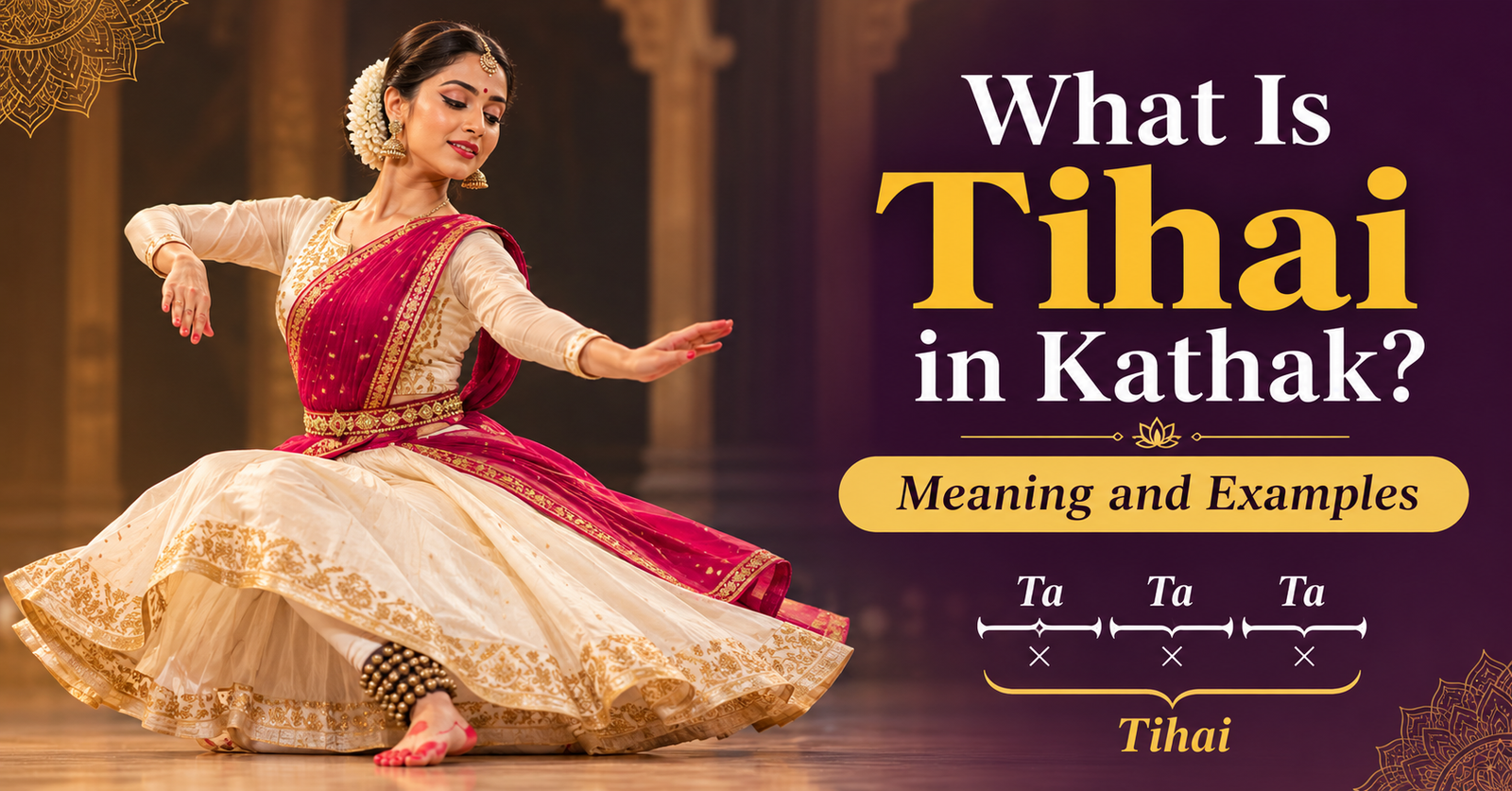
A Tihai is a rhythmic phrase performed three times so that the final syllable of the third repetition resolves on the sam, the first and most important beat of the taal cycle. Tihai is one of the most recognisable rhythmic devices in Kathak and can appear in footwork, bols, tukdas, parans, improvisation and musical accompaniment. Understanding Tihai helps students connect movement with precise rhythmic calculation.
A beginner watching Kathak often notices a thrilling moment when a dancer repeats the same rhythmic phrase three times and lands exactly with the music. That sense of anticipation and resolution is one of the pleasures of Tihai. It sounds effortless in performance, but it requires careful awareness of taal, matra, laya and sam. Learning Tihai teaches students to think rhythmically rather than simply memorise steps.
What Does Tihai Mean in Kathak?
In Kathak, a Tihai is a rhythmic phrase repeated three times, arranged so that the last syllable or movement of the third repetition lands on sam. Sam is the first beat of the taal cycle and acts as a major point of resolution.
A Tihai may be recited through bols, played on tabla, performed through tatkaar or built into a longer composition. It can mark the end of a section, create emphasis or demonstrate the dancer’s command over rhythm.
Why Does a Tihai Repeat Three Times?
The threefold repetition creates recognition. The first repetition introduces the phrase, the second confirms the pattern and the third builds expectation toward sam. The audience begins to anticipate the landing even if they are not consciously counting every matra.
This is why Tihai can feel both mathematical and dramatic. The calculation gives it structure, while the repetition gives it emotional impact.
Important Terms to Understand Before Learning Tihai
Taal
Taal is the rhythmic cycle. Teentaal, for example, contains sixteen matras arranged in four divisions of four beats each.
Matra
A matra is a beat or time unit within the taal. When a teacher says a Tihai begins on a particular matra, they are identifying its starting position inside the cycle.
Sam
Sam is the first beat of the cycle and the most important landing point in many Kathak compositions. Dancers often emphasise sam with a clear movement, pose or strong foot placement.
Avartan
One complete cycle of the taal is called an avartan. A Tihai may fit within one avartan or extend across more than one depending on its length.
Laya
Laya is tempo or speed. The same Tihai may feel very different in slow, medium or fast laya.
The Basic Structure of a Tihai
A Tihai contains three repetitions of the same rhythmic idea. In a simple bedam Tihai, the repetitions follow continuously. In a damdar Tihai, equal pauses appear between the three phrases.
Teachers often teach students to calculate the total rhythmic space occupied by three phrases plus any gaps, then determine where the Tihai must begin so that the final bol lands on sam.
Bedam Tihai: No Pause Between Repetitions
Bedam literally indicates that there is no breathing space or pause between the three repetitions. The phrase flows directly into the next repetition.
For example, imagine a five-matra phrase in Teentaal. If that phrase is repeated continuously three times, it occupies fifteen matras. When arranged to begin at the correct point in the cycle, the final matra of the third repetition can resolve on the next sam.
Simple counting illustration
Think of the phrase as five counts: 1-2-3-4-5. Repeat it three times without a gap: 1-2-3-4-5 | 1-2-3-4-5 | 1-2-3-4-5. A teacher then places this fifteen-count structure in the taal so that the last count coincides with sam.
Damdar Tihai: Equal Pauses Between the Three Phrases
A damdar Tihai contains a pause after the first phrase and another equal pause after the second phrase. These pauses are part of the rhythmic calculation.
For example, if the phrase is four matras long and there are two matras of rest after the first and second repetitions, the structure occupies sixteen rhythmic units: 4 + 2 + 4 + 2 + 4. In Teentaal, the teacher can position this pattern so its final stroke lands on the required sam.
A Simple Teentaal Example for Beginners
Teentaal has sixteen matras. Instead of beginning with difficult bols, a beginner can first clap or step a short rhythmic phrase three times while the teacher keeps theka. The student’s job is to hear the cycle and recognise where sam will arrive.
Once the counting is stable, the teacher may replace numbers with Kathak bols or tatkaar. This progression is important because students who memorise only the spoken phrase may perform it correctly once but struggle if the starting matra changes.
How Tihai Appears in Kathak Footwork?
A Tihai can be created from tatkaar. The dancer repeats a selected footwork pattern three times and lands the final stroke on sam. Because the sound of ghungroo makes the rhythm audible, the audience can hear the repetition as well as see it.
Students learning Kathak in Dubai gradually move from basic rhythm and tatkaar toward more complex rhythmic structures such as Tihai as their control improves.
Tihai in Tukda and Paran
Kathak compositions such as tukdas and parans often conclude with a Tihai. The main composition develops a rhythmic idea, and the threefold ending creates a clear resolution.
This does not mean every Tihai is a separate composition. Sometimes Tihai is the concluding structure inside a larger composition.
What Is a Chakradhar Tihai?
A chakradhar is a more elaborate structure in which a composition containing a Tihai is itself repeated three times, producing a layered threefold design. It is more advanced because the dancer must manage a much larger rhythmic calculation.
Beginners should first become comfortable with simple bedam and damdar Tihais before studying complex chakradhar patterns.
Why Tihai Is So Important in Kathak?
Tihai trains several essential skills at once. The dancer must maintain laya, remember the phrase, understand the taal cycle and control the final landing. It develops rhythmic awareness far beyond simply following music.
It also encourages improvisational thinking. Experienced Kathak dancers can create or adapt rhythmic patterns while remaining aware of the approaching sam.
How to Calculate a Tihai?
A useful beginner method is to identify the phrase length, multiply it by three, add the two equal gaps if the Tihai is damdar and then compare the total with the rhythmic space available before sam.
The arithmetic is only a tool. The final goal is to feel the rhythm through recitation, clapping, footwork and musical accompaniment rather than depending on written calculation during performance.
Common Tihai Mistakes Beginners Make
One common mistake is speeding up the second or third repetition because the student becomes anxious about reaching sam. Another is changing the phrase slightly between repetitions. A Tihai requires the phrase to remain structurally consistent.
Students may also focus so intensely on counting that they lose posture or expression. Good training gradually integrates rhythm with the full dance body.
How to Practise Tihai Step by Step
First recite the phrase clearly. Next clap the taal while speaking it. Then identify the sam and starting matra. After that, add simple footwork. Only when the rhythm is stable should the student increase speed or add chakkars.
Practising with tabla or lehra recordings can help, but teacher correction is especially valuable because a student may not notice a small timing error that shifts the final landing.
From Counting to Musical Confidence
At first, Tihai feels like mathematics. With practice, the calculation becomes musical intuition. The dancer begins to sense how much rhythmic space remains and how the repeated phrase will resolve.
Students interested in developing rhythm, tatkaar, chakkars and expressive technique can explore Upaj Academy’s classical Kathak classes in Dubai and learn more about its Kathak teaching approach.
- All Posts
- Bharatanatayam
- Blog
- Bollywood
- kathak
- Zumba