
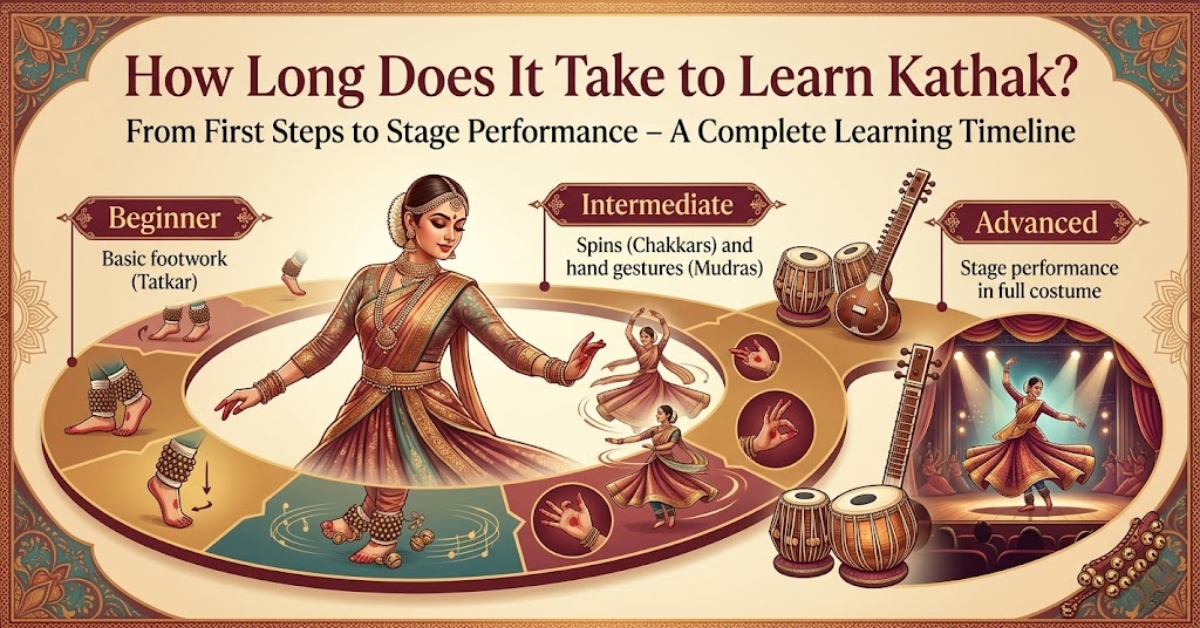
Summary: Learning Kathak is a deeply personal journey that varies based on your dedication, prior dance experience, and the depth of mastery you seek. Whether you’re a curious beginner or an aspiring performer, this guide breaks down the realistic timelines, milestones, and factors that shape your Kathak learning path.
Kathak is one of the eight classical dance forms of India — a mesmerizing blend of rhythmic footwork, graceful gestures, expressive storytelling, and spiritual depth. Born in the temples of North India and refined in the royal courts of Lucknow and Jaipur, Kathak is not just a dance; it is a language of the soul.
If you’ve ever watched a Kathak performer spin in rapid chakkar turns or strike the floor with precise tatkar footwork, you may have wondered: “How long would it take me to learn this?” The honest answer is — it depends. But with the right guidance, consistent practice, and a passionate teacher, your Kathak journey can be one of the most rewarding experiences of your life.
Let’s break it down stage by stage.
How Long Does It Take to Learn Kathak? A Stage-by-Stage Breakdown
Stage 1: Beginner Level (0–1 Year)
The first year of Kathak is all about building a strong foundation. You will learn the basic tatkar (rhythmic footwork), fundamental hand gestures ( mudras ), body posture, and simple compositions called tukdas and toras.
During this phase, students typically attend one to two classes per week. Most beginners start to feel comfortable with basic rhythmic patterns within three to six months. By the end of the first year, a dedicated student can perform simple compositions and understand elementary taal (rhythmic cycles) like Teentaal (16 beats).
What you’ll learn:
- Basic stance and posture (samabhanga position)
- Simple tatkar patterns in slow (vilambit) tempo
- Introductory mudras and abhinaya (expressions)
- Basic compositions like thaat and amad
Stage 2: Intermediate Level (1–4 Years)
This is where Kathak truly begins to open up. Between years one and four, students dive deeper into complex footwork patterns, layered rhythmic compositions, spinning (chakkar), and expressive storytelling through abhinaya.
You will explore different ragas (musical modes), learn thumri and bhajan expressions, and begin performing in front of small audiences. This stage is often the most transformative students develop their unique artistic voice here.
Most students completing this phase can perform a structured recital of 30–45 minutes and may appear in stage productions or cultural events.
What you’ll learn:
- Fast and medium tempo tatkar
- Chakkar (spins) in multiple counts
- Paran, kavit, and layered compositions
- Expressive abhinaya from mythological stories
- Understanding of tal compositions in Jhaptaal, Ektaal, and Rupaktaal
Stage 3: Advanced Level (4–7 Years)
By this stage, you move from learning Kathak to living Kathak. Advanced students work on solo recitals (ekl pradarshan), begin to develop their individual gharana style (Lucknow or Jaipur), and may pursue formal certifications or diplomas from recognized institutions.
Advanced practitioners refine the nuances of laya (tempo), explore improvisation within structured frameworks, and develop strong connections with live musicians. This stage typically culminates in a Visharad (proficiency diploma) examination.
Stage 4: Mastery and Beyond (7–12+ Years)
True mastery of Kathak — the kind you see in concert halls and on international stages — takes a decade or more. At this level, dancers not only perform with technical precision but communicate deep emotion, philosophy, and spiritual meaning through their art.
Legendary Kathak maestros like Birju Maharaj spent their entire lives refining this craft. Mastery is not a destination; it is a continuous, evolving journey.
Key Factors That Affect How Fast You Learn Kathak
Your Age and Prior Dance Background
Children between 5 and 10 years tend to absorb movement patterns and rhythms quickly. However, adults are by no means disadvantaged — they often bring greater emotional depth and discipline to the art. If you already have training in any classical or folk dance form, your learning curve may be shorter.
Frequency and Quality of Practice
The single biggest factor in your progress is how consistently you practice. Students who practice 30–60 minutes daily alongside weekly classes progress two to three times faster than those who only practice during class time.
The Guru-Shishya Relationship
Kathak has traditionally been passed down through the guru-shishya parampara — the sacred bond between teacher and student. Having a knowledgeable, experienced, and personally invested teacher accelerates learning dramatically. The right guru doesn’t just teach steps; they transmit the bhav (spirit) of the art.
Your Goal: Hobby vs. Performance vs. Mastery
If you wish to learn Kathak as a hobby or a form of fitness and mindfulness, even six months of regular classes can be deeply fulfilling. If you aim to perform on stage, plan for two to four years. If you aspire to teach or achieve professional mastery, commit to seven or more years.
Is It Ever Too Late to Start Learning Kathak?
Absolutely not. Many students begin Kathak in their 30s, 40s, and even 50s — and find it life-changing. While professional performance timelines may differ, the joy, discipline, physical fitness, and cultural connection that Kathak offers are available to learners at any age.
Your Kathak Journey Starts with a Single Step!
Kathak is not something you simply “learn” and check off a list. It is a lifelong relationship with rhythm, grace, expression, and culture. Whether it takes you one year to feel confident on the dance floor or ten years to grace a professional stage, every step of this journey is meaningful and transformative.
The real question isn’t how long it takes — it’s when you’ll start.
Start Your Kathak Journey with Upaj Academy!
At Upaj Academy, we believe every learner is a dancer waiting to be awakened. Our expert instructors offer the Best Kathak Classes in Dubai, with structured courses for all age groups and skill levels — from complete beginners to advanced students preparing for stage performances and examinations.
Why Choose Upaj Academy?
- Experienced and certified Kathak instructors rooted in classical tradition
- Flexible batch timings for children, teenagers, and adults
- Structured curriculum from beginner to Visharad level
- A nurturing, culturally rich learning environment
- Both online and offline learning options available
🎶 Contact Upaj Academy today and take your first step into the beautiful world of Kathak!