Summary: This guide breaks down the realistic timeline for learning Bharatanatyam, from mastering basic steps to performing a solo debut (Arangetram). It explores the different stages of learning—beginner, intermediate, and advanced—and discusses key factors that influence your progress, such as practice consistency, age, and individual goals. Whether you are learning for fitness or professional performance, this article helps set the right expectations for your dance journey.
One of the most common questions aspiring dancers ask is, “When will I be ready to perform?” In a world of crash courses and instant results, Bharatanatyam remains a steadfast exception. It is not just a dance; it is a discipline that requires patience, endurance, and dedication.
While there is no single finish line, the journey can generally be mapped out in distinct phases. Understanding these milestones will help you stay motivated and set realistic goals.
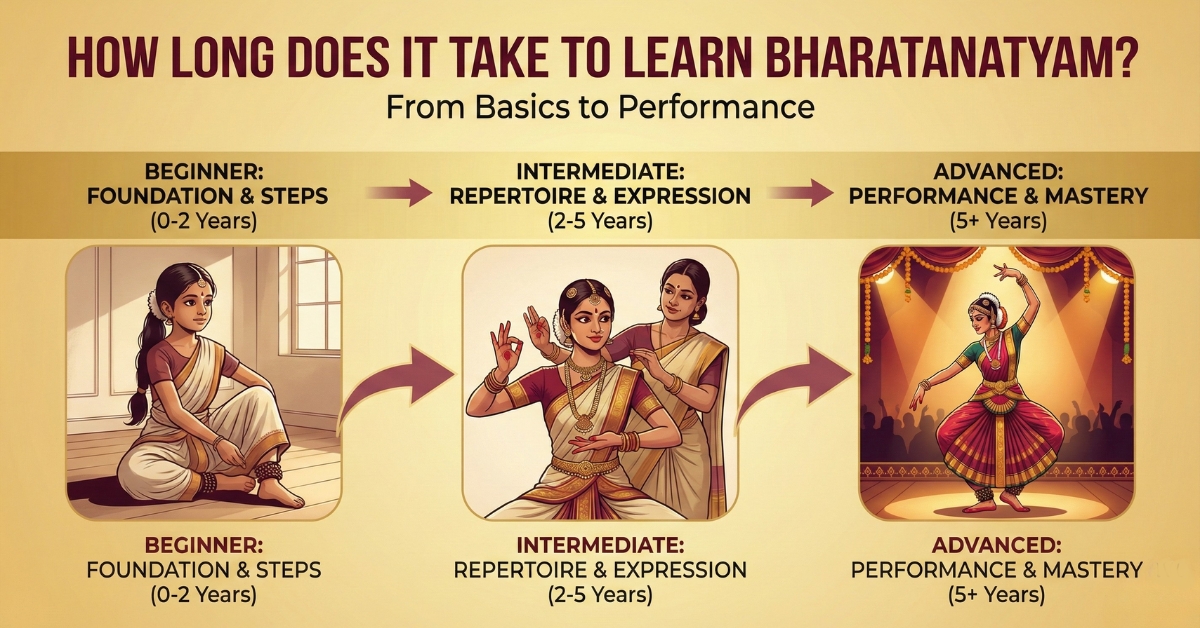
1. The Foundation Phase (0 to 1 Year)
The first year is often the most physically demanding but also the most crucial. During this time, you are not just learning steps; you are retraining your body to hold the fundamental posture.
What You Will Learn?
- Adavus (Basic Steps): There are roughly 60 to 100 distinct steps divided into families (like Tatta, Natta, Mandi). You will spend months perfecting the rhythm and geometry of these movements.
- Posture (Araimandi): Developing the strength to hold the half-sit posture for extended periods without compromising your back or knees.
- Hastas (Hand Gestures): Memorizing the single and double-hand gestures that form the alphabet of the dance.
Goal: By the end of year one, you should be able to execute the basic adavus with correct rhythm (Talam) and posture.
2. Building the Repertoire (Years 2 to 4)
Once your foundation is strong, you will begin learning the Margam (the traditional repertoire). This is where the dance transforms from repetitive drills into fluid artistic expression.
The Items You Will Master
- Alarippu: An invocation piece that warms up the body and focuses on rhythm.
- Jatiswaram: A pure dance piece (Nritta) that combines complex adavu patterns with musical notes.
- Shabdam: Your introduction to Abhinaya (expression), where you begin to interpret lyrics and tell stories through facial expressions and hand gestures.
- Varnam: The centerpiece of Bharatanatyam. This is a demanding item that tests your stamina, combining intricate footwork with deep emotional storytelling.
Goal: By the end of this phase, you will have the stamina to dance for 20-30 minutes continuously and the ability to convey basic emotions.
3. The Road to Arangetram (Years 5 to 7+)
For many, the Arangetram (solo stage debut) is the ultimate milestone. It signifies that the student is now capable of performing a full concert solo.
Preparation for Debut
Reaching this stage typically takes a minimum of 5 to 7 years of consistent training (at least 2-3 times a week). The preparation for the event itself is intense, often requiring 6 to 12 months of daily practice to build the endurance needed for a 2-hour performance.
Note: An Arangetram is not a “graduation” in the sense that learning stops; rather, it is a commencement of your journey as a serious artist.
4. Factors That Influence Your Timeline
The “5 to 7 years” rule is an average, not a law. Several factors can speed up or slow down your progress.
Frequency of Practice
A student who practices 15 minutes daily will progress significantly faster than one who attends a 2-hour class once a week but never practices at home. Muscle memory is built through repetition, not just instruction.
Age and Fitness Level
- Children: Often have better flexibility but may take longer to grasp the subtle emotional nuances (Abhinaya).
- Adults: Often understand the theory and emotions faster but may need more time to condition their bodies for the deep knee bends (Araimandi).
Your Personal Goals
Not everyone aims for an Arangetram. If your goal is fitness, cultural connection, or stress relief, you can feel a sense of accomplishment within just a few months of mastering the basics.
5. Can You Learn Faster?
While you cannot rush art, you can optimize your learning.
- Private Lessons: One-on-one attention can correct errors immediately, preventing bad habits from setting in.
- Listening to Carnatic Music: Familiarizing yourself with the music structure helps you understand the rhythm (Talam) intuitively, saving time in class.
- Supplemental Fitness: Yoga and Pilates complement Bharatanatyam perfectly by building the core strength and flexibility required for the dance.
Embracing the Endless Rhythm of Learning!
So, how long does it take to learn Bharatanatyam? To learn the basics, it takes a year. To perform a debut, it takes roughly six years. To master the art? It takes a lifetime.
The beauty of Bharatanatyam lies in the fact that there is always more to discover—a new mythological story to interpret, a complex rhythm to master, or a deeper emotional layer to uncover. The joy is found not in the finish line, but in every step of the dance.
If you are ready to embark on this endless journey, finding the best bharatanatyam classes near Dubai Marina is the perfect place to start your training.
- All Posts
- Bharatanatayam
- Blog
- Bollywood
- kathak
- Zumba